Toplines: How Courts And Defenders Of Gerrymandering Misused an Obscure Rule to Disenfranchise 2.5 Million People

Weaponized misapplications of Purcell have harmed civil rights.
Voting rights litigation serves as an important check on discriminatory elections legislation, especially as election rules are increasingly politicized. This is particularly true when gerrymandered legislatures, intent on holding onto unearned power, pass one restriction after another—including by passing even more extremely gerrymandered maps, as we are seeing now. Unfortunately, courts are increasingly putting time on the side of states who are passing new, burdensome voting laws and biased maps, at the expense of voters.
Twenty years ago, the U.S. Supreme Court identified a seemingly-neutral concept that federal courts should avoid adjusting election rules too close to an election to prevent voter confusion, in a case called Purcell v. Gonzalez. But as new data shows, Purcell is now misused as an arbitrary bar against civil rights enforcement and voter relief. Purcell, which applies earliest in redistricting cases, forced over 2.49 million people to vote in districts already found to likely violate federal law in 2022 alone.
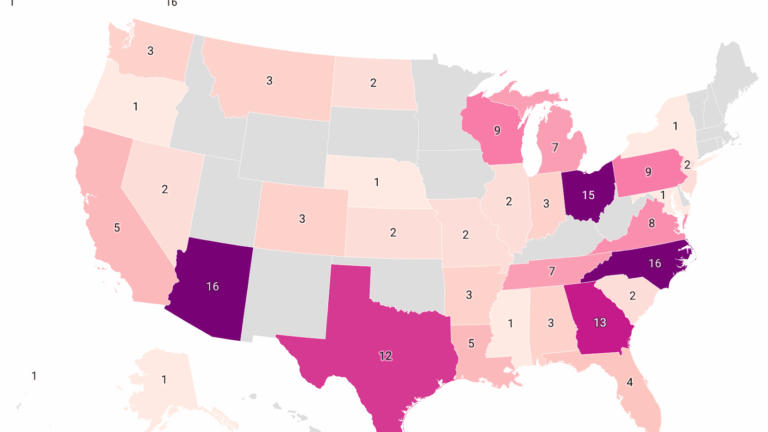
Purcell Applied, Cases by State and Territory (2006-2024)
Figure 1. This map shows the rate of cases applying Purcell by state and territory from 2006 through 2024. Darker states have had the concept invoked more frequently.
Key Points:
- Notwithstanding Purcell‘s focus on imminence, courts do not use the concept to avoid changes closer to elections, but instead use Purcell to avoid protecting voters no matter how far away the election is. Empirical research shows that a decision issued three months before the general election is only 3.4 percentage points more likely to apply Purcell than one issued six months before.
- Redistricting cases apply Purcell very unevenly across time relative to other election law applications of Purcell, such as ballot initiative cases.
- Purcell is applied most frequently in states with heavily gerrymandered legislatures, including Georgia, North Carolina, Ohio, Texas, and Wisconsin—enabling skewed legislatures to pass last-minute changes to keep their unearned power.
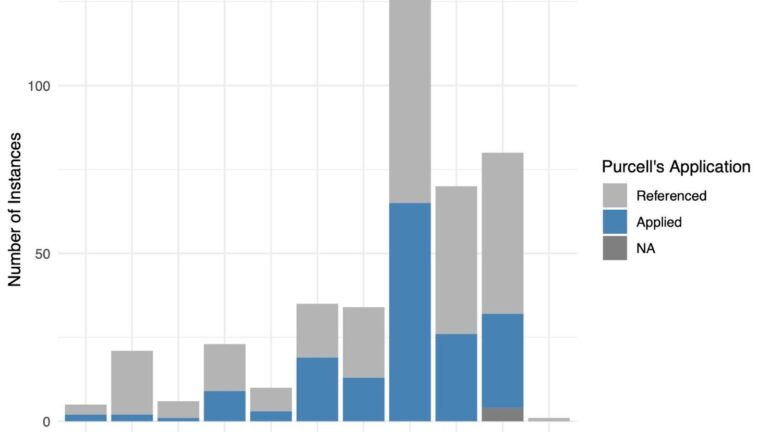
Courts are considering and applying Purcell much more since 2016, and delaying implementation of new, legal maps by giving states longer to implement maps than in the early 1980s—despite significant increases in map-drawing technology.
Rate of Cases Citing Purcell by Election Cycle (2006-2024)
Figure 2. This stacked bar graph details the rate of judicial opinions citing and applying Purcell from 2006 through 2024, by election cycle.
The full report is available to download here.
Ensure Every Voice Counts
The National Redistricting Foundation works to advance fair representation, so voters—not political interests—shape our democracy.