Census IRS Rule Threatens College Town Representation

Using IRS data fails to count college students accurately, wildly distorting
population data.
The Census Bureau has proposed concerning changes to the 2030 Census.
A Notice of Proposed Rulemaking (NPRM) issued by the Census Bureau would make a number of significant changes to the 2030 Census, with detrimental results. First, the proposed rule attempts to fundamentally alter the scope of the 2030 Census by excluding, for purposes of counting as a resident of a state, any noncitizen who is not a lawful permanent resident—a change that would exclude tens of millions of people, primarily targeting undocumented individuals, citizens of foreign countries, approved asylum seekers and refugees, and H-1B visa holders. The proposed rule also seeks to preclude the 2030 Census from asking any questions concerning race, ethnicity, or sexual orientation—breaking with longstanding practice—and seeks to adjust the enumeration period to manipulate the results. Each of these proposed changes is extremely concerning and has rightfully received significant pushback.
But there is yet another drastic and concerning change: the NPRM proposes to change the definition of “usual residence” to make it “consistent with, and evidenced by, their tax records.”
Preliminary analyses indicate that the proposed “tax records change” could make it nearly impossible for colleges and universities to be fully represented in decennial census data.
While the NPRM is ambiguous about how any implementation will occur, a preliminary analysis indicates that areas with particularly high proportions of people who may be listed as dependents on others’ tax forms may be severely affected—and smaller towns that are home to large universities would be among the hardest hit. In many cases, college towns could practically disappear from the data, because many students are listed as dependents on their parents’ taxes. And college towns that are home to schools with high international student enrollment would be doubly hit, considering proposed changes to H-1B visas and proposed changes to whether or how noncitizens will be counted.
Because census data controls massive amounts of federal funding, this could result in a significant funding hit to college towns and, in turn, to higher education institutions themselves.
NRF’s Analysis
To estimate how many people the Census Bureau may miss if it implements the proposed “tax records” change, the NRF compared Internal Revenue Service (IRS) 2023 Statistics of Income data, published at the county level for all individuals and the dependents they claim, with the American Community Survey (ACS) 2025 Vintage data, 2023 estimates.1
The most recent public IRS data available is from 2023; IRS data released from 2021-2023 did not show any significant increases in the number of individuals filing or being claimed as dependents, so projecting out changes
from the IRS dataset post-2023 would likely not produce meaningful results.
While the discrepancy between the IRS data and the ACS data is caused by a number of factors – low-income citizens who are not required to file a tax return and incarcerated people, for example, will not be reflected in IRS data – college towns are a particularly pronounced part of the story.
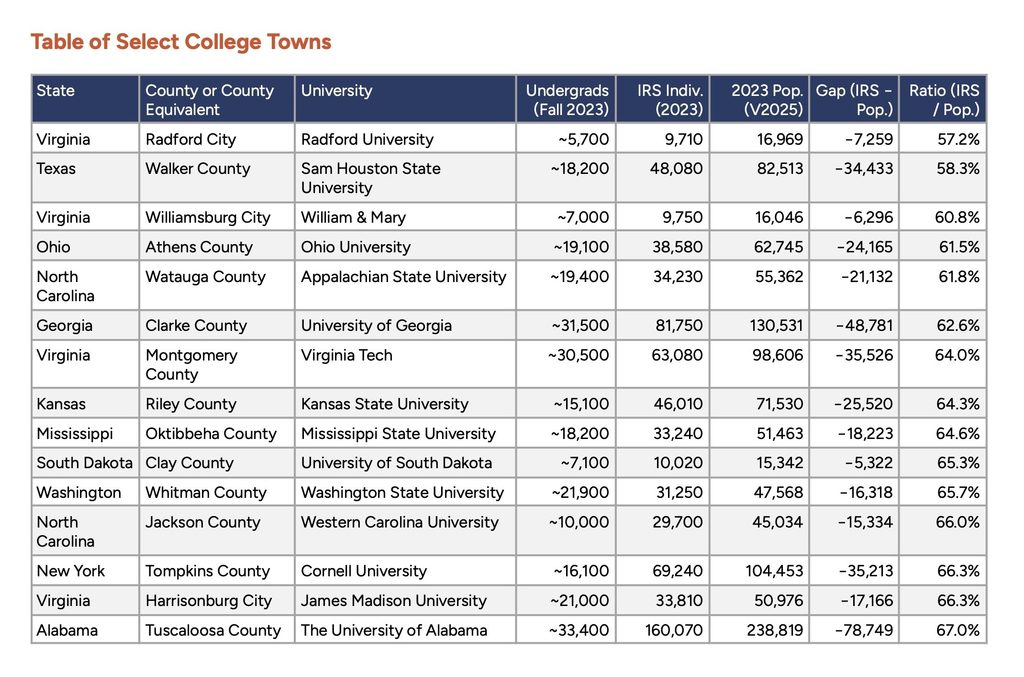
Less populated counties that host universities, regardless of state, have some of the greatest discrepancies between the populations reflected by IRS and ACS data, respectively. This is most evident in counties where the university dominates the local population and economy (as the table
below illustrates). In some counties, the population drops off by as much as 30-40% when the data is confined to IRS data, instead of the more comprehensive ACS data.
Large student populations are counted as residents by the ACS, but many students either aren’t independent filers or are claimed as dependents on a parent’s return filed elsewhere — so they don’t register as separate “IRS Individuals” where they attend school. Across the 38 largest flagship and
land-grant universities in these counties, IRS individuals average just 73.5% of the ACS population estimate, versus 85.8% in all other counties.2
Comments on the NPRM are due by Monday, November 2. The U.S. Census Bureau is accepting public comments for the next few weeks as they consider whether to adopt this dangerous new policy. The public comment period is open through November 2. Individuals and organizations can submit comments here.
- 1 The most recent public IRS data available is from 2023; IRS data released from 2021-2023 did not show any
significant increases in the number of individuals filing or being claimed as dependents, so projecting out changes
from the IRS dataset post-2023 would likely not produce meaningful results. ↩︎ - This reflects flagship/land-grant universities with more than 5,000 undergraduates, where those undergraduates
make up over 10% of the county’s population. ↩︎
Ensure Every Voice Counts
The National Redistricting Foundation works to advance fair representation, so voters—not political interests—shape our democracy.